
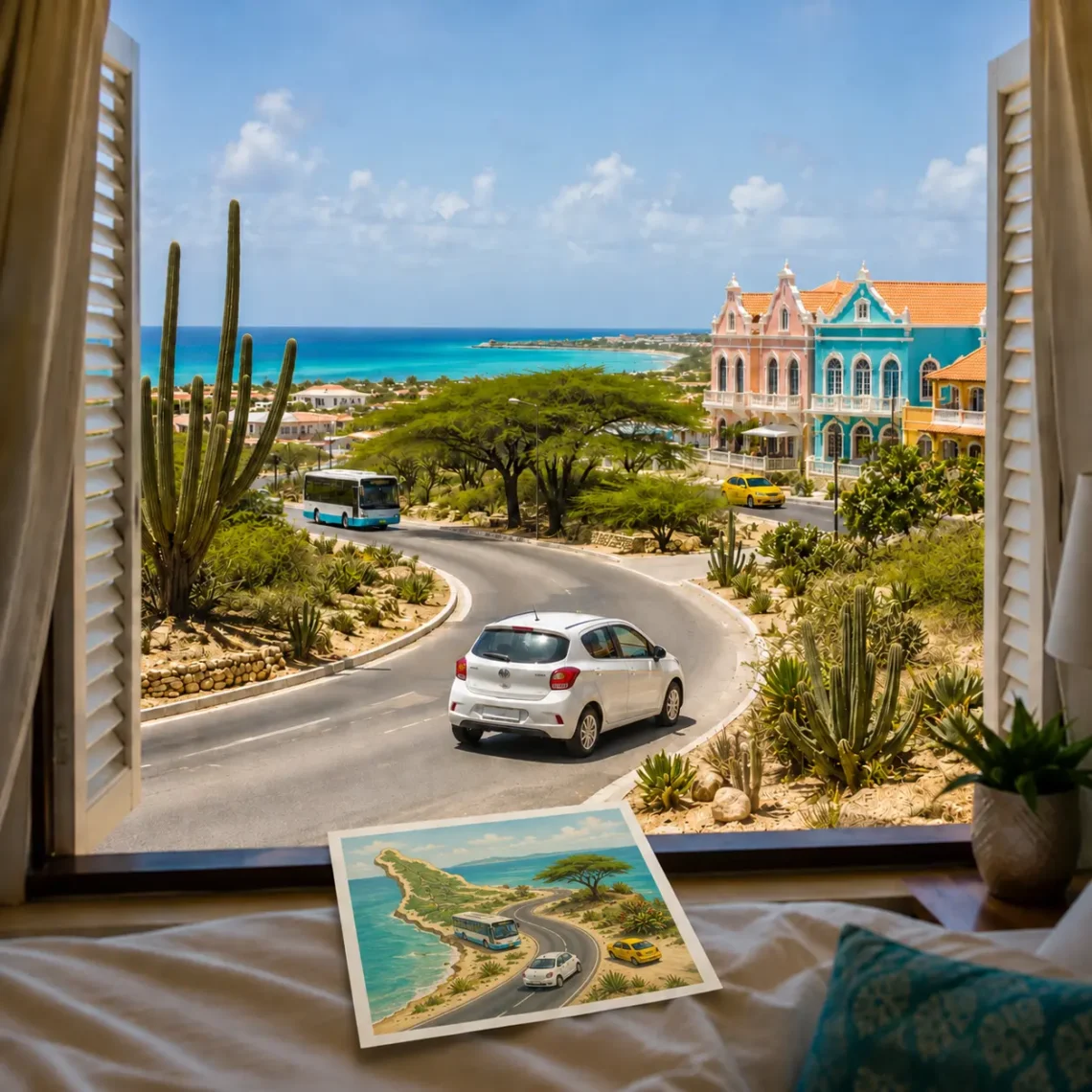
Getting Around Aruba: Rental Car, Bus, Taxi & Practical Tips
What is the best way to get around Aruba? The island is compact, but its beaches, hotel areas, Oranjestad, San Nicolas and Arikok are spread out enough that it pays to think about transport before you arrive. The right choice depends mainly on where you stay and how much of Aruba you want to explore.
I lived on Aruba for about six months in 2020, near Palm Beach, and I have returned almost every year since, most recently in 2026. During a longer stay, you quickly learn that distances may look short on a map, yet having your own car gives you much more freedom for beaches, supermarkets, viewpoints and trips to the south.
In this guide, I compare rental cars, 4x4s, Arubus, taxis and private transfers. I also explain how to travel from the airport, what driving and parking are like, and which option works best for different types of Aruba vacations.
This page contains affiliate links. If you book through them, we may earn a commission at no extra cost to you. Learn more.
🚗 My short answer: if you mainly stay around Palm Beach and only plan a few outings, you can manage without a rental car. If you want to visit several beaches, Arikok, San Nicolas and Baby Beach independently, I would rent one. A regular car is sufficient for most paved roads; the direct off-road route to Natural Pool (Conchi) requires a suitable 4×4 or an organized tour.
Want to fit the different transportation options into a realistic plan? Use my 7-, 10-, or 14-day Aruba itinerary as your starting point.
🚦 Getting around Aruba at a glance
| Your vacation | Best option | Why? |
|---|---|---|
| Mainly Palm Beach and a resort | Walking, bus and taxi | Many facilities are nearby |
| Palm Beach plus a few day trips | Taxi, bus or a car for a few days | You may not need a car every day |
| Several beaches | Rental car | Easy to combine different places |
| Arikok and the caves | Car or tour | Suitable for the main route; check road access |
| Natural Pool (Conchi) | 4×4 or tour | The direct route is rough and off-road |
| San Nicolas and Baby Beach | Rental car or bus | A car offers freedom; the bus is cheaper |
| Oranjestad and the hotel area | Arubus | Affordable coastal connections |
| Dinner or a night out | Taxi | No one has to drive |
🧭 In this guide
- Do you need a rental car?
- Transport from Aruba Airport
- Renting a car in Aruba
- Regular car, SUV or 4×4?
- Driving and traffic rules
- Parking and fuel
- Arubus and public transport
- Taxis and transfers
- Walking and cycling
- Transport costs
- My advice by area
- Frequently asked questions
Want to include transport in the rest of your planning? Start with my complete Aruba travel guide. My comparison of the best areas to stay in Aruba will also help you choose a convenient base.
🚗 Do you need a rental car in Aruba?
A rental car is not essential for every Aruba vacation. Around Palm Beach, many hotels, restaurants, shops, beaches and activities are within a relatively small area. Buses also connect the hotel zone with Oranjestad and Arashi. If your plans center on the resort and nearby beach, you can comfortably stay without a car.
The situation changes when you want to combine different parts of the island. Eagle Beach, Arashi, Mangel Halto, Baby Beach, San Nicolas and Arikok do not all sit along one convenient route. With a car, you can leave early, stop spontaneously and visit several places in one day without arranging your plans around bus timetables or repeated taxi fares.
That freedom was particularly useful during my own stay. You do not have to turn every day into a full island tour. Being able to pick up groceries, drive to a quieter beach later in the afternoon or stop at a viewpoint on the way makes everyday travel easier.
🌴 A practical compromise: staying for a week around Palm Beach or Eagle Beach does not automatically mean renting a car for all seven days. Plan a few relaxed beach days without one and rent a car for two or three dedicated island days.
✈️ Transport from Aruba Airport
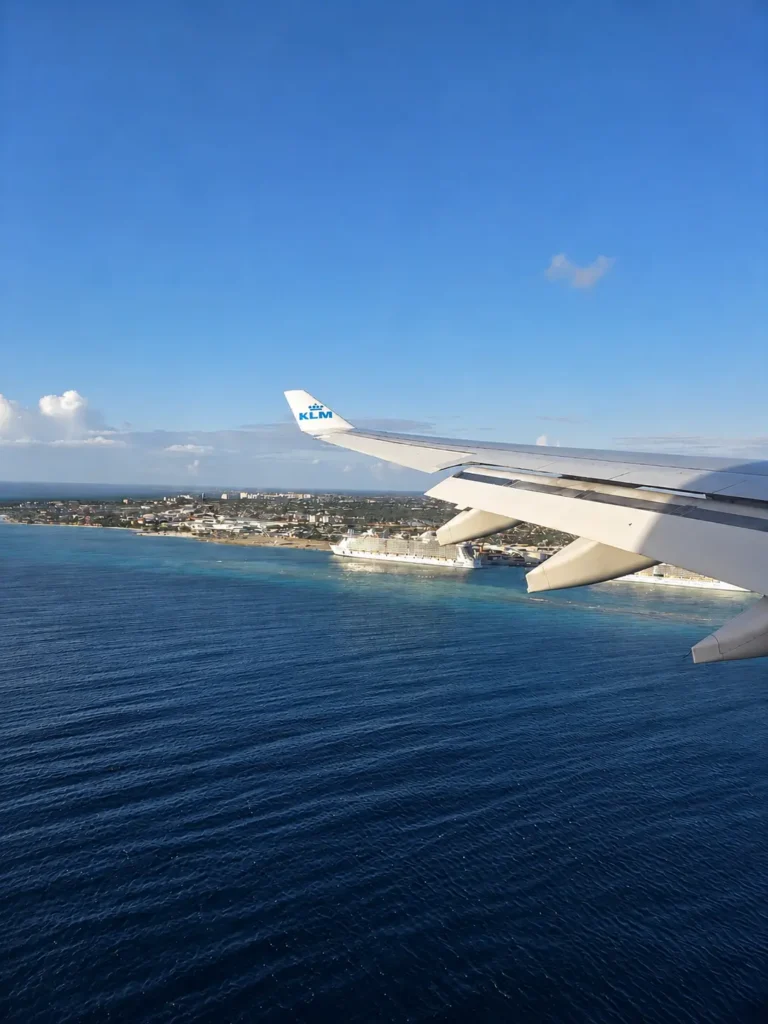
Queen Beatrix International Airport lies southeast of Oranjestad. From the terminal, you can continue by rental car, taxi, pre-booked transfer or Arubus.
Picking up a rental car at the airport
Several rental companies have desks at the arrivals terminal. Others operate from nearby locations and provide a shuttle. When comparing offers, check more than the price: confirm the exact pick-up point, opening hours and how to recognize the shuttle.
Taxi or private transfer
Taxis are available after arrival and official fares are regulated by the government. A pre-booked transfer can be convenient for families, larger groups or anyone who wants to know exactly who will be waiting after a long flight.
Taking Arubus from the airport
Public bus stops are located just outside the airport grounds. Arubus services run towards Oranjestad and San Nicolas. This is the cheapest option, although it may not be the easiest with luggage or if your accommodation is far from a stop.
Before traveling, check the latest public transport information from Aruba Airport and then verify the timetable with Arubus. Routes and departure times can change.
🔑 Renting a car in Aruba
Do not compare rental cars by the basic daily price alone. Look at insurance, the security deposit, excess, mileage limits, additional drivers, fuel policy and restrictions on unpaved roads. A cheap-looking offer can cost more once essential cover is added.
- Driver’s license: requirements differ by company. Many ask you to have held a valid license for at least two years; check whether an international driving permit is also required.
- Minimum age: this varies by rental company and vehicle category. Younger drivers may pay a surcharge.
- Deposit: a credit card or security deposit is common. Check the amount and whose name must be on the card.
- Insurance: read what is and is not covered, especially glass, tires, underbody damage and unpaved roads.
- Pick-up and return: photograph existing damage and record the fuel level.
- Off-road use: never assume that every SUV or Jeep may be driven on every unpaved route.
Official Aruba information commonly mentions a valid driver’s license held for at least two years and a deposit or credit card. Each rental company can set its own conditions, so the terms in your booking always take priority.
🚙 Comparing rental cars
If you want to explore independently, compare vehicle categories and insurance conditions in advance. Do not automatically choose the largest car: for ordinary island driving, a compact model is often easier to park and uses less fuel.
Compare all-inclusive rental cars in Aruba
Check current prices for your travel dates. With Sunny Cars, insurance, unlimited mileage and reimbursement of the excess are included in the all-inclusive package.
- Insurance included
- Reimbursement of the excess
- Free cancellation until one hour before the rental starts
You will continue to Sunny Cars to check availability and the conditions for your dates.
🛻 Regular car, SUV or 4×4?
A regular rental car is generally sufficient for the paved roads between the airport, Oranjestad, Palm Beach, Eagle Beach, Noord, Savaneta, San Nicolas and Baby Beach. Aruba is easy to navigate and its main visitor routes are accessible.
A higher SUV may feel more comfortable on rougher roads, but an SUV is not automatically a true 4×4. Check both the drivetrain and the rental conditions before choosing one.
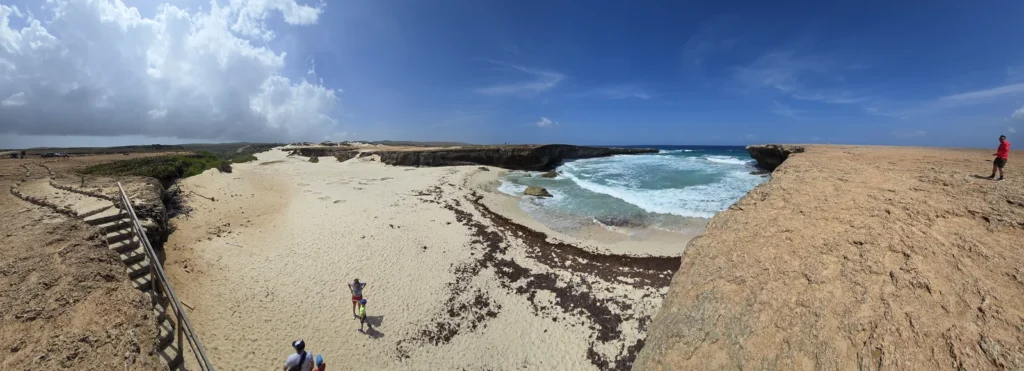
When do you need a 4×4?
The direct off-road route to Natural Pool, also known as Conchi, requires a suitable 4×4. An organized jeep tour is a sensible alternative if you lack experience on rough terrain or your rental agreement excludes the route.
Conditions are different around the visitor entrance, visitor center, Fontein Cave, Quadirikiri Cave and other areas of the park. Read my complete guide to Arikok National Park and Conchi and check which roads are open when you visit.
⚠️ Important: driving on beaches, sand dunes and in the ocean is prohibited in Aruba. Stay on permitted roads and respect closures and protected natural areas.
🛣️ Driving and traffic rules in Aruba
Traffic drives on the right in Aruba and you overtake on the left. Visitors from North America and most of continental Europe will find this familiar. Roundabouts, local driving habits, unfamiliar junctions and slippery roads after rain still deserve extra attention.
- Built-up areas: the general speed limit is 30 km/h.
- Outside built-up areas: generally 60 km/h.
- Faster roads: up to 80 km/h where permitted.
- Road signs: the posted limit always takes priority over the general rule.
- Roundabouts: traffic already on the roundabout has priority.
- Unmarked junctions: traffic from the right has priority unless signs or markings state otherwise.
- Red lights: always stop; turning right on red is not permitted.
- Rain: roads can become slippery because oil and dust collect on the surface.
Read the official guidance on driving in Aruba, and always follow current signs and temporary traffic measures during your trip.
Navigation in Aruba
Navigation apps generally work well, but addresses and access roads are not always as precise as you may be used to. Around beaches and nature areas, check that the suggested route is both suitable and permitted for your vehicle.

📱 My tip: download an offline map of Aruba before setting out. You will still be able to navigate if you temporarily lose mobile data.
🅿️ Parking and fuel in Aruba
Parking is free at many beaches and attractions, but always pay attention to signs, road markings and entrances. Do not park on sidewalks or outside marked spaces, and never leave valuables visible inside the car.
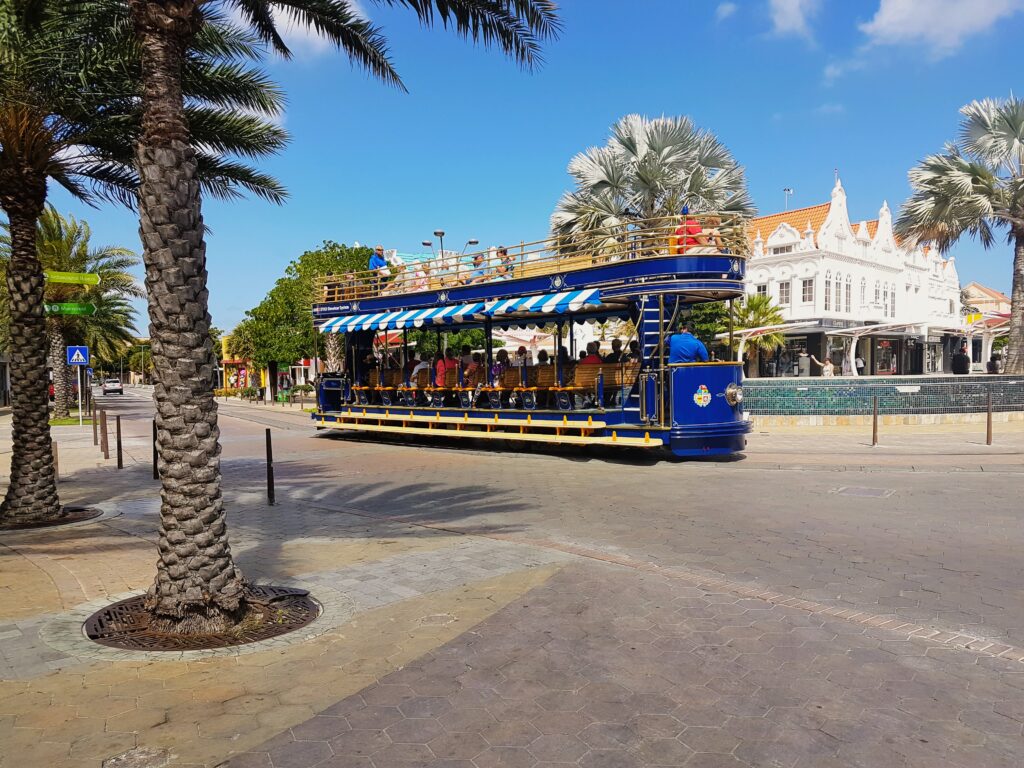
Parking in Oranjestad
Paid parking operates through Aruparking in parts of central Oranjestad. Regular spaces are marked with white lines, while yellow spaces are reserved for permit holders and employees. Check the signs or payment machine for the current hours and instructions.
You can also park outside the busiest streets and walk the final section into the center. For ideas on what to combine along the way, see my overview of the best things to do in Aruba.
Filling up
There are enough gas stations around Aruba for normal travel. When touring the south or the rougher north coast, do not wait until the tank is nearly empty. At pick-up, confirm which fuel the car uses and the level at which it must be returned.
Payment and service can differ between stations. If you are unsure, ask an attendant how the process works and check the amount before paying.
🚌 Arubus and public transport
Arubus is Aruba’s government-owned public bus company. Its most convenient services connect Oranjestad, Eagle Beach, Palm Beach, the hotel area and Arashi. Other routes serve San Nicolas, Savaneta, the airport and Baby Beach.
| Route or area | Useful connection |
|---|---|
| Oranjestad – hotel area – Arashi | L10 services |
| Oranjestad – San Nicolas | L1, L2 and L3A, depending on the route |
| Airport | L2 is among the routes serving the airport area |
| San Nicolas – Baby Beach | L900 |
| San Nicolas – hotel area – Oranjestad | L11 non-stop according to the current timetable |
The standard fares currently published by Arubus are:
- One way: US$2.60 or AWG 4.50.
- Return ticket: US$5.00 or AWG 8.75.
- Day pass: US$15.00 or AWG 26.25.
Fares and routes can change. Shortly before traveling, check the current Arubus fares and the latest routes and timetables.
Who is the bus best for?
- Travelers on a smaller transport budget.
- Anyone staying along the hotel route.
- Visitors who plan one main destination per day.
- Anyone who does not want or is unable to rent a car.
The bus can be very practical for a beach day at Eagle Beach or Arashi. If you want to combine Arashi, California Lighthouse, Alto Vista and the rugged north coast in a single day, a rental car or tour will be much more efficient.
🚕 Taxis and transfers in Aruba
Aruban taxis do not use a conventional meter. Fares are set by the government, and Taxi.aw lets you calculate the official price for a route in advance. It is still sensible to confirm the fare with the driver before leaving.
- Minimum fare: US$10 or AWG 18.
- Base fare: covers one to four passengers.
- Additional passenger: US$3 per person, with a maximum of seven passengers per taxi.
- Surcharge: US$5 on Sundays, official public holidays, daily from 11 p.m. to 7 a.m. and from 24 December through 1 January.
- Luggage: airport trips include one suitcase and one backpack or handbag per passenger; extra luggage may cost more.
- Payment: keep US dollars or Aruban florins in cash available.
A taxi is ideal for an occasional restaurant visit, an airport journey or an evening when nobody wants to drive. If you need several taxis every day to explore the island, compare the total with the cost of a rental car.
Pre-booked transfer
A transfer is particularly useful for larger groups, travelers with plenty of luggage or accommodation outside the main hotel areas. Check whether the quote is per person or per vehicle and whether the return journey is included.
🚶 Walking and cycling in Aruba
You can cover plenty on foot within Palm Beach and parts of Oranjestad, and short walks around the main beaches are easy. Walking is not a full substitute for transport everywhere: distances feel longer in the heat, sidewalks are missing along some roads and traffic can be busy.
A bicycle or e-bike can be enjoyable for a specific outing or route. Take the sun, wind, heat and traffic seriously. Use suitable protection, carry enough water and preferably choose a planned route or guided ride. I would only recommend cycling as everyday island transport to experienced cyclists who understand the conditions.
☀️ Do not underestimate the heat: the trade wind may feel cooling while you are still exposed to intense sunshine. Carry water and sun protection even for a relatively short walk or ride.
💰 How much does transport cost in Aruba?
Your total depends on the travel period, vehicle class, insurance and number of passengers. A bus has the lowest cost per journey, but a rental car can become better value per person for a family or group visiting many places.
| Transport | How the cost works | Best suited to |
|---|---|---|
| Arubus | Low fixed fare per trip or a day pass | Budgets and the hotel route |
| Taxi | Fixed route fare plus possible surcharges | Occasional rides and evenings |
| Transfer | Price agreed in advance | Airport travel, groups or lots of luggage |
| Compact rental car | Daily rate, insurance, deposit and fuel | Independent island exploring |
| SUV or 4×4 | Higher rental and fuel costs | Specific rougher routes |
| Tour | Price per person or group | Arikok and off-road trips without driving yourself |
Do not calculate the rental rate alone. Include insurance, fuel, possible parking charges and airport or location fees. Then compare that total with the taxi journeys and tours you would otherwise book.
📍 My transport advice by area
| Where are you staying? | My advice |
|---|---|
| Palm Beach | Possible without a car; rent one for dedicated island days |
| Eagle Beach | Bus and taxi are possible; a car helps with restaurants and day trips |
| Noord | A rental car is usually recommended |
| Oranjestad | Walk or take the bus in town and to the hotel area; rent a car for island days |
| Savaneta | A rental car is almost always practical |
| San Nicolas | A car provides the most freedom; buses work with advance planning |
For a closer comparison of these locations, read Where to Stay in Aruba. If beaches are your main priority, continue with my guide to the best beaches in Aruba.
For a day in the south, I would combine San Nicolas and Baby Beach. My guide to San Nicolas and its street art explains which places work well together.
🚗 What I would choose: for a first vacation of about a week that includes more than the hotel and nearest beach, I would rent a compact car. I would only arrange a proper 4×4 or jeep tour for the day if Conchi is definitely on the itinerary.
❓ Frequently asked questions about transport in Aruba
Do you really need a rental car in Aruba?
No. Around Palm Beach and along the hotel route, you can walk, use the bus and take an occasional taxi. A rental car becomes valuable when you want to combine several beaches, Arikok, San Nicolas and Baby Beach independently.
Can I use my driver’s license in Aruba?
Rental companies generally accept a valid driver’s license, often on the condition that you have held it for at least two years. Requirements for an international driving permit, minimum age and deposit differ by company, so check the booking terms before paying.
Do you need a 4×4 for Arikok?
Not for every part of Arikok, but you do for the direct off-road route to Natural Pool (Conchi). Check which park roads are open and whether your rental agreement allows off-road use. A jeep tour is a good alternative.
Do you drive on the left or right in Aruba?
Traffic drives on the right in Aruba, and overtaking is on the left.
Can you take a bus to Baby Beach?
Yes. Arubus publishes the L900 route between San Nicolas and Baby Beach. From Oranjestad, you will normally travel to San Nicolas first. Always check the latest timetable because services can be less frequent than along the hotel zone.
Can you take a bus from Aruba Airport?
Yes. Bus stops are located just outside the airport grounds. With luggage or after a late arrival, however, a taxi, transfer or rental car may be more convenient.
Are taxis expensive in Aruba?
A taxi can be practical for an occasional journey. Fares are regulated and calculated by route rather than by meter. If you plan several long journeys every day, a rental car may cost less overall.
Is parking easy in Aruba?
At many beaches and attractions, yes. Paid parking applies in parts of Oranjestad, where you should pay close attention to white and yellow markings. Park only in permitted spaces and leave no valuables visible.
Conclusion: which transport suits your Aruba vacation?
The best choice depends less on Aruba’s size than on your plans. You can stay without a car for a relaxed resort vacation around Palm Beach. If beaches, nature, Oranjestad and the south all feature in your itinerary, a rental car gives you considerably more freedom.
My preference is a compact car for ordinary island driving and a genuine 4×4 or organized tour only when the route demands it. That way, you do not pay extra for an off-road vehicle throughout the vacation when you only need it for one day.
Planning your route now? Combine this transport guide with my articles about things to do in Aruba, the best beaches, Arikok National Park and San Nicolas.
Ready to explore Aruba at your own pace?
Compare available rental cars for your travel dates and choose a vehicle that matches your route.
Still planning your stay? Read our accommodation and area guide to choose a base that fits your route.
Discover more from DutchieWorldTravel
Subscribe to get the latest posts sent to your email.




2 Comments
Pingback:
Pingback: